Modern motorcycle technology has advanced dramatically in the last decade. Systems that were exclusive to the premium segment ten years ago are now appearing as standard equipment on affordable models – and it's no accident. Increased safety, comfort, and convenience are no longer a privilege of expensive motorcycles. LETBE has recognized this and incorporated it into its offerings. This text explains what each of these technologies actually does and why it's worth considering when choosing a motorcycle.
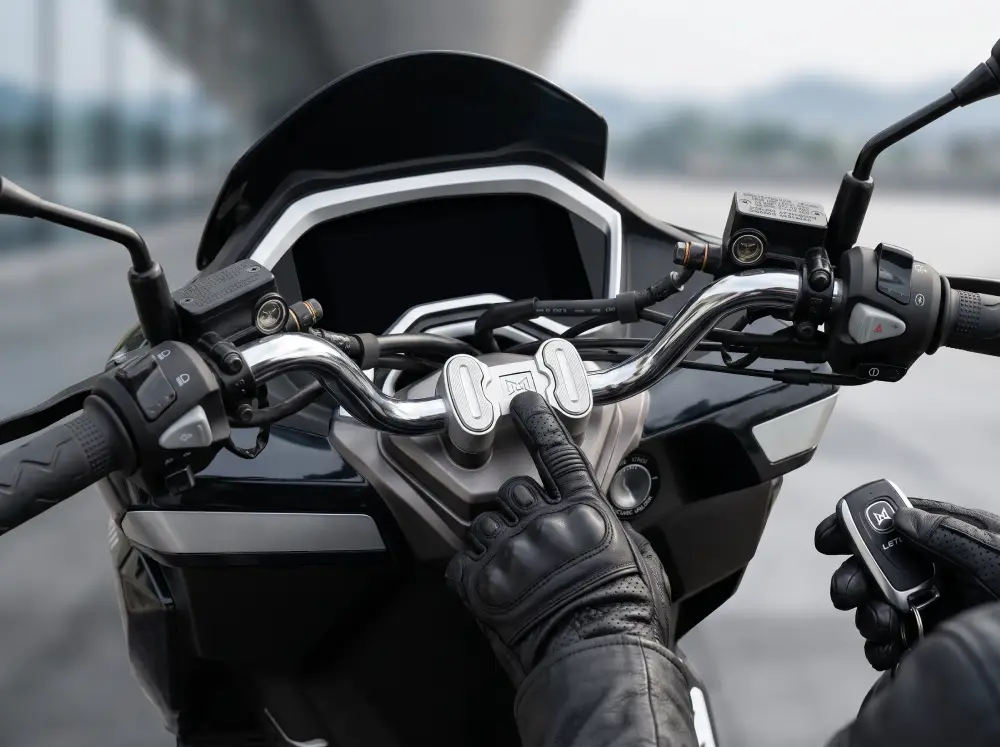
The keyless start system, which comes standard on most LETBE models, eliminates the physical key from the driver-vehicle interaction. The system works via RFID (Radio Frequency Identification) technology – the key is actually a fob or card that emits a signal, and the engine recognizes the presence of this signal and allows the engine to be started without physically inserting a key.
In everyday use, this means the following: you get to the scooter, the accompanying fob is in your pocket or bag, you press the start button, and the engine starts. No taking a key out of your pocket, no inserting it, no fumbling for the lock on the handlebar in the dark or rain.
This may sound like a small thing, but it's becoming a valuable habit. There are no more lost keys. The security advantage is also real – copying a physical key is trivial, while cloning an RFID signal requires specialized equipment and knowledge.
ABS (Anti-lock Braking System) is an electronic system that monitors the rotational speed of the wheels during braking and prevents them from locking up. When the driver brakes suddenly, the ABS detects in milliseconds that a wheel is slowing down faster than is appropriate for the vehicle's speed—a signal that the wheel is beginning to lock up—and cyclically releases and applies the brake, maintaining the wheel's rotation at maximum braking force.
In practical terms, ABS means that a driver who panics and slams on the brakes retains the ability to steer the motorcycle. Without an ABS system, a locked front wheel almost certainly means a crash. With an ABS system, locking the front wheel is impossible – the system takes control of the braking force and maintains rotation.
Let Be Neon comes with the CBS system as standard equipment, which automatically distributes braking force between both wheels and ensures predictable stopping in all conditions. On wet surfaces, gravel, or the dirtier asphalt typical of less-trafficked streets in Serbian cities, the CBS system actively reduces the risk of critical situations that would otherwise depend solely on the driver's experience and reaction. Velocity 200cc is a model in the lineup that comes with an ABS system — a higher level of electronic braking protection for the driver who wants maximum support in this category.
TCS (Traction Control System), or traction control, is a system that monitors rear wheel slip during acceleration. When sensors detect that the rear wheel is rotating faster than it should for the given vehicle speed – a spin signal – the system reduces engine power or applies the brake to the rear wheel until traction is re-established.
In urban conditions, TCS is particularly valuable on wet pavement, while navigating curved streetcar tracks, on surfaces with sand or gravel, and during sudden accelerations from intersections. For experienced drivers, these are situations that are successfully handled with experience and careful throttle modulation. For novices and average drivers, TCS is an electronic safety net that intervenes before the driver even recognizes a problem.
Island 150cc comes with the TCS system as standard. Island Thanks to its four-valve liquid-cooled engine and these systems, it is the most technically advanced scooter in the entire 150cc lineup.
CBS (Combined Braking System) is a different type of electronic braking assistance. While ABS prevents wheel lock-up, CBS automatically distributes braking force between the front and rear wheels, regardless of which brake lever or pedal the driver activates.
On motorcycles with the CBS system, applying pressure to one brake activates both wheels in a pre-determined and optimized proportion. This means that a rider who, out of habit or panic, brakes with only one system (e.g., just the rear) still gets some braking force on the front wheel – which reduces the overall stopping distance.
Tara i Aurora They come with a CBS system that, combined with front and rear discs, provides reliable stopping tailored for less experienced drivers who are just developing their intuition for balancing braking force between both wheels.
CVT (Continuously Variable Transmission), or a stepless automatic transmission, is a technology that eliminates discrete transmission gears – no clutch, no shifting. The transmission adjusts continuously and seamlessly, from start to top speed.
This is especially valuable in urban conditions with frequent stops and starts, as the driver can focus on traffic instead of shifting techniques. Tara, Aurora, Neon, Mecha i Velocity use a CVT transmission – which makes them intuitive for beginners and comfortable for daily use even for experienced drivers.
A modern instrument panel is not just a speedometer. Aurora Features a VA instrument screen that displays speed, fuel, distance traveled, and other relevant information clearly and legibly in all lighting conditions. Tara uses an LCD panel with similar information in a more compact format.
Clear and legible information in the driver's line of sight reduces the need to divert one's gaze and attention from the road, which is an easily overlooked safety factor.
Technologies that were once exclusive to the premium segment – keyless start, ABS, TCS, CBS, CVT, and digital instruments – are now available in the affordable segment through LETBE offer. For all details about which model carries which systems, the team is available via Contact page.


